The School Day Length Myth: What Global Data Really Tells Us About Australian Timetabling
Comparing the world's shortest and longest school days reveals a hard truth for Australian education: more hours in class doesn't mean better outcomes. Here's what the data shows.
Aug 14, 2026
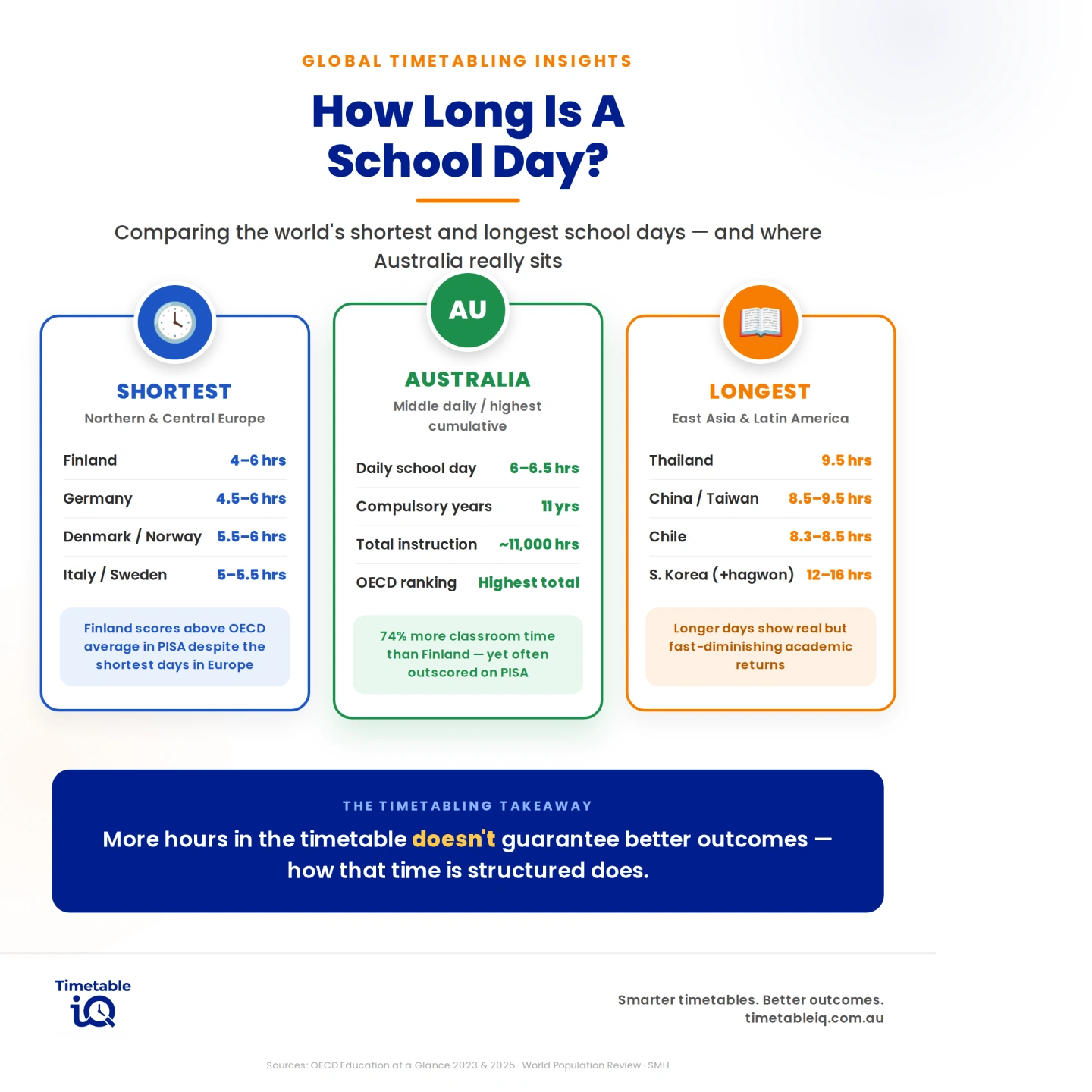
Ask most parents which country has the "best" school system, and they'll often point to whichever one keeps kids in class the longest. It's an intuitive assumption — more time learning should mean more learning. The global data says otherwise, and Australia is one of the clearest examples of why.
The countries with the shortest school days
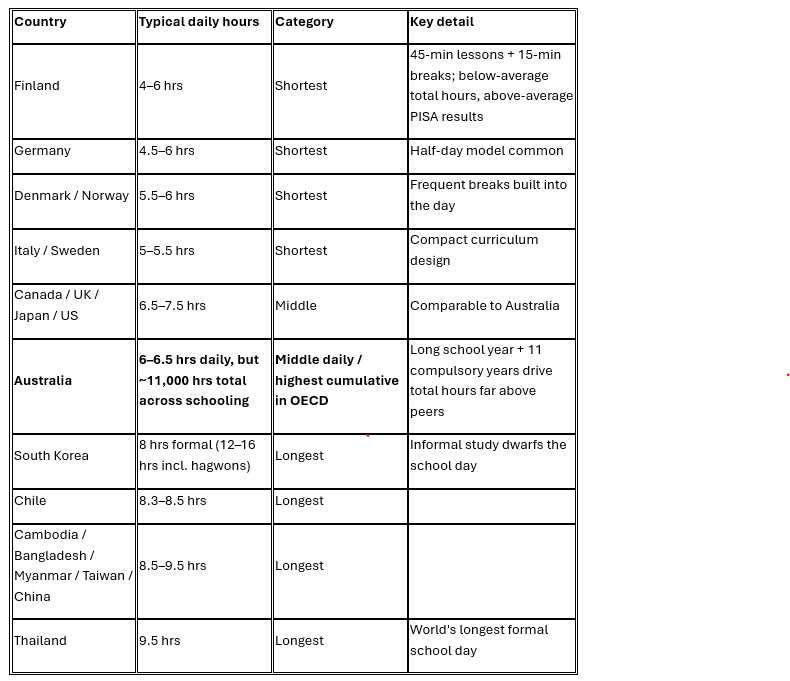
Finland is the benchmark case. Younger primary students attend for as little as 4–5 hours a day, built around a rhythm of 45 minutes of teaching followed by a 15-minute break — often spent outdoors (Eurydice, oppischools.fi). Germany, Denmark, Norway, Italy and Sweden sit in a similar band, at roughly 4.5–6 hours a day (World Population Review).
Despite the shortest days in the developed world, Finland consistently scores above the OECD average in PISA reading and Maths (oppischools.fi) — a result that has puzzled policymakers who assume time-on-task drives achievement.
The countries with the longest school days
At the other extreme, Thailand runs the world's longest formal school day at around 9.5 hours (ExpertBeacon). China and Taiwan aren't far behind, and several Southeast Asian and Latin American systems — Cambodia, Bangladesh, Myanmar, Chile — sit in the 8.5–9 hour range (World Population Review).
South Korea is the most extreme case once informal study is counted: the official school day runs to around 8 hours, but most students then attend "hagwon" cram schools and self-study sessions until 9pm or later, pushing total daily study time to 12–16 hours (InterNations, Namhan South Korea).
Where Australia actually sits
Here's the counterintuitive part: Australia's daily school hours are unremarkable. A standard NSW day runs roughly 8:45am–3pm — about 6 to 6.5 hours, in the same range as Canada, the UK, Japan and the US (DE International NSW).
The outlier is cumulative instructional time, driven by a long school year and 11 years of compulsory schooling. Australian students receive around 1,000 compulsory instruction hours a year in both primary and lower secondary — well above the OECD averages of 804 and 909 hours — totalling roughly 11,000 hours across compulsory schooling, versus an OECD average of ~7,634 hours and just ~6,300 hours in Finland (OECD, 2025, OECD, 2023).
And yet, despite spending roughly 74% more time in the classroom than Finnish students, Australian students are regularly outperformed by them on PISA (SMH).
Global comparison at a glance
Sources: World Population Review, OECD Education at a Glance 2023 & 2025, ExpertBeacon, SMH
What this means for Australian schools
The research on instructional time is consistent on one point: adding hours produces real but modest gains — and only up to a point. A global synthesis of 40 studies found benefits of 0.05–0.22 standard deviations when moving from an inadequate 4–5 hour day to 7–8 hours, but those gains flatten sharply beyond that (Zenodo synthesis, HEDCO Institute). Australia is well past that threshold. Longer days also carry real costs — fatigue, reduced concentration, higher absenteeism, and higher operating costs (OECD) — while Australian teachers already carry some of the highest face-to-face teaching loads in the OECD (EducationHQ).
For school leaders and timetablers, the takeaway isn't "cut hours" or "add hours" — it's that how instructional time is structured matters more than how much of it there is: lesson length, break frequency, teacher autonomy, and targeting time toward the students who benefit most. That's a timetabling design question, not just a policy one — and it's exactly where good scheduling decisions can outperform simply adding minutes to the day.
Janice Edwards - Timetable iQ