The Minimum Hours Myth: What ACARA and the States Actually Require Australian Schools to Timetable
Following our look at school day length myths, we dug into the fine print of ACARA and every state curriculum authority. The finding: most schools have no clear picture of their real subject-hour floor.
Aug 17, 2026
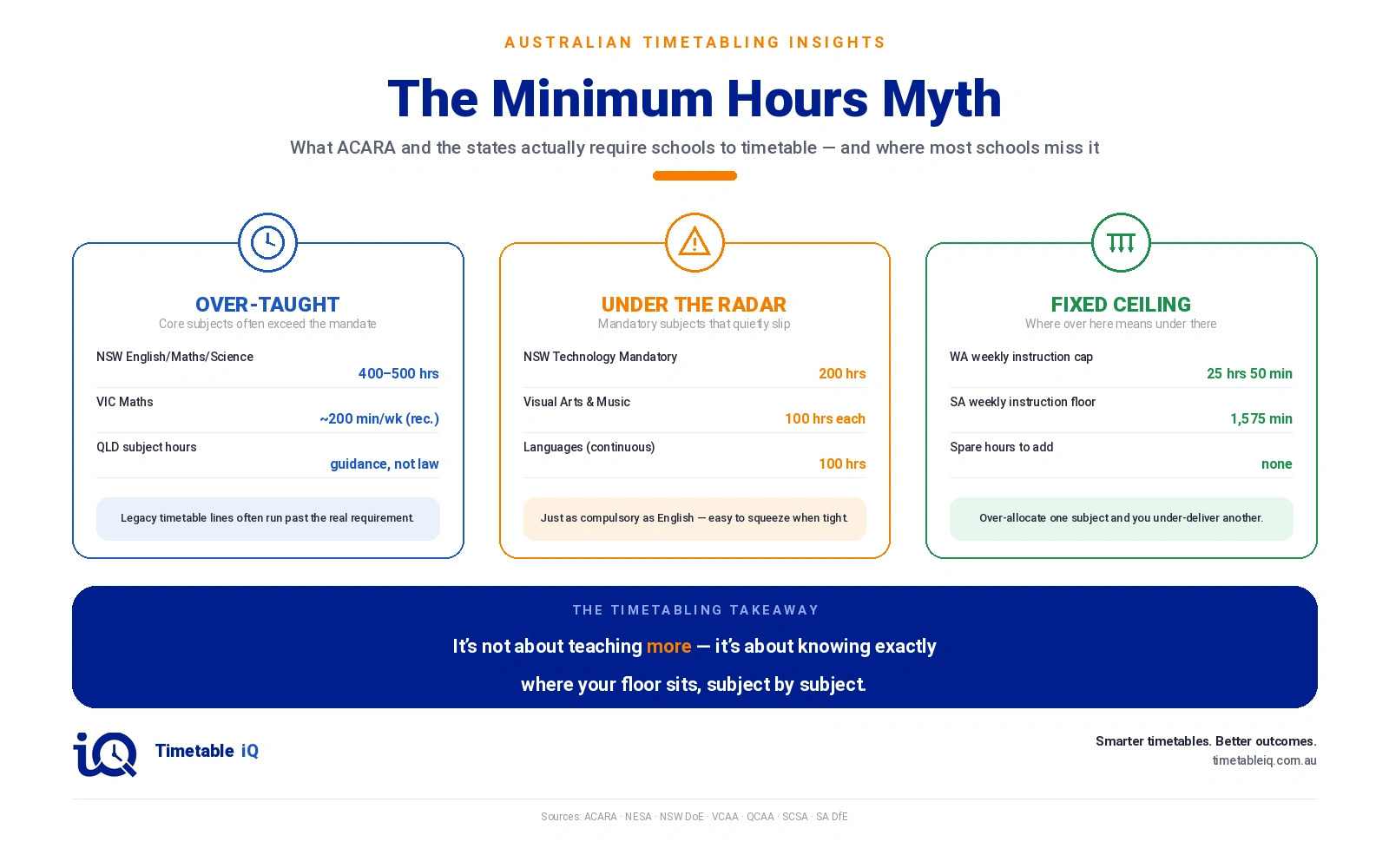
Following our look at school day length myths, we dug into the fine print of ACARA and every state curriculum authority. The finding: most schools have no clear picture of their real subject-hour floor — and it's costing them lines they don't need to spend, while quietly under-delivering the ones they can't afford to lose.
Last time, we compared school day length across the globe and found that Australia's real outlier isn't its daily hours — it's cumulative instructional time, and that extra time hasn't bought better PISA results than Finland's much shorter day. The obvious next question for anyone who builds timetables: if more total hours doesn't equal better outcomes, what does the picture look like one level down — inside the timetable, subject by subject?
We went through ACARA's curriculum design documents and every state and territory curriculum authority's rules to find the actual answer. What we found is a genuine paradox playing out in schools every year: many are timetabling well beyond what's required in some subjects, while quietly falling short in others — often without realising either is happening.
ACARA sets the content, not the clock
It's worth saying plainly: ACARA does not mandate how many hours a school must teach a subject. The Australian Curriculum website states that "time allocations for delivery of subjects in schools are determined by relevant education authorities in each state or territory, or by an individual school" (Australian Curriculum V9 Help). The only indicative time table ACARA has ever published sits in its 2012, Version 8-era Curriculum Design Paper v3.1, built on an assumed 1,000 teaching hours a year with the whole curriculum capped at 80% of available time. No equivalent table exists for the current Version 9.0 curriculum. Every hour figure a school actually has to hit comes from its own state or territory — and those rules vary enormously.
The over-allocation problem: English and Maths get the comfortable margin
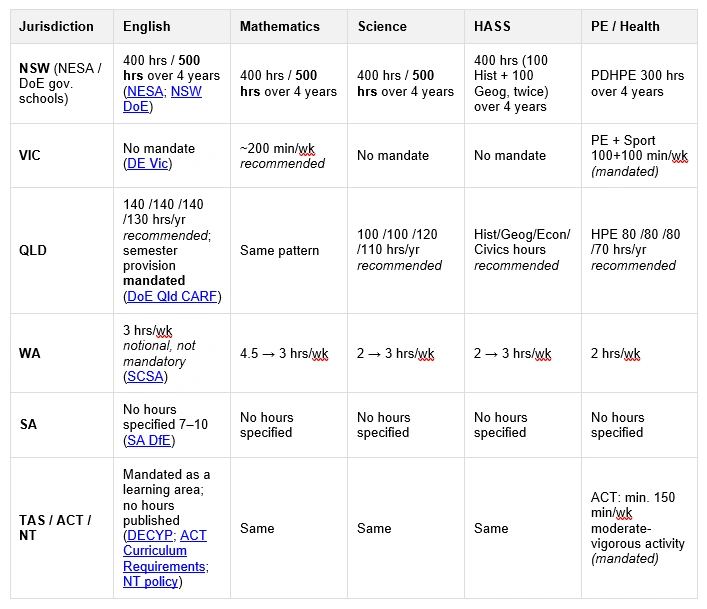
NSW is the only jurisdiction with hard, auditable hour mandates for Years 7–10: NESA requires 400 hours each for English, Mathematics, Science and HSIE, and 300 for PDHPE, with NSW government schools required to hit even higher DoE figures of 500 hours for English, Maths and Science (NESA ACE 5; NSW DoE Curriculum policy standards). Those numbers sound generous already — and in practice, many schools' timetables run past even the higher figure, because legacy line structures and a cultural assumption that "more English and Maths is always safer" tend to outlive the actual regulatory requirement. Once a school has built five periods of Maths a week for a decade, nobody questions whether the mandate is actually four.
Outside NSW, the pattern is even looser. Victoria doesn't mandate subject hours at all in Years 7–10 beyond a recommendation of about 200 minutes a week for Maths — "time allocations are not mandated in other learning areas" (DE Vic Curriculum Programs F–10 policy). Queensland publishes detailed recommended hour tables (English and Maths both around 140 hours a year in Years 7–9), but the actual legal requirement is only that the subject be offered every semester — the hours themselves are guidance, not law (DoE Qld P–12 Curriculum, Assessment and Reporting Framework). In both states, a school that's timetabling well above the recommended figure isn't breaking any rule — but it may be spending lines on margin it doesn't need, at the expense of subjects that are genuinely tight.
The under-allocation risk: the mandatory subjects nobody watches
Here's the part that should worry timetablers more. In NSW, Technology Mandatory carries its own 200-hour requirement across Years 7–8, Visual Arts and Music each carry 100 hours, and Languages require 100 hours of continuous study somewhere in Years 7–10 (NESA ACE 5). These are just as mandatory as English or Maths — but because they're smaller allocations, delivered in blocks rather than every year, and treated informally as "the elective-adjacent subjects," they're the ones most likely to get quietly squeezed when a timetable is under construction pressure. A school confident it's compliant because English and Maths look generous can still be in breach on Technology or Languages without anyone noticing until a registration audit asks for the total hours per course — which NESA explicitly requires schools to be able to produce (NSW Registration Process for the Government Schooling System Manual).
Western Australia flips the risk in the other direction. SCSA publishes notional weekly hours per learning area but states plainly that they are "not mandatory" — the real constraint is the total time available, capped at a strict 25 hours 50 minutes a week and 4 hours 10 minutes a day across the whole school (SCSA Advice on Time Allocation; DoE WA Configuration of the School Day Procedures). South Australia works the same way, with a hard floor of 1,575 minutes of instruction a week but almost no per-subject breakdown after primary school (SA DfE Organising the school year procedure). In these states, there's no such thing as "too much" time in one subject without it coming directly out of another — the ceiling is fixed, so over-allocation in one place is definitionally under-allocation somewhere else.
Senior secondary has its own version of this myth
The same over/under pattern shows up in the unit-hours conversion that underpins Years 11–12 everywhere. NSW syllabuses are based on 60 hours per unit — meaning a standard 2-unit course requires 120 hours a year, or 240 across Preliminary and HSC combined, not the 200 hours widely assumed (NESA Curriculum for senior secondary education). Get that number wrong in either direction and you're either over-building a line the syllabus doesn't require or under-delivering a course you're certifying as complete. Queensland, Western Australia and the ACT converge on roughly 55 hours per unit, Victoria uses a minimum of 50, and South Australia and the Northern Territory work in credits at roughly 60 hours per 10 — six genuinely different arithmetic rules sitting behind what looks, from the staffroom, like the same generic "unit" (QCAA QCE Handbook; SCSA WACE Manual 2024; VCAA VCE Administrative Handbook; SACE Board Policy Framework).
Cross-jurisdiction snapshot: Years 7–10 mandates compared
The takeaway for school leaders
The lesson from the school day length data was that structure beats volume. The lesson here is closely related: compliance isn't about teaching more — it's about knowing precisely where your floor actually sits, subject by subject, in your own state. Most schools can find spare capacity in over-built core lines and redirect it toward the mandatory subjects quietly running under the line, without adding a single extra hour to the week. That's not a curriculum problem. It's a timetable design problem — and it's exactly the audit I run with schools before construction starts each year.
Where do you think your school is more likely to be over-teaching — and where might it actually be under-delivering without knowing it?
Janice Edwards - Timetable iQ