Schools Did Not Ask Principals to Become Accountants. Why Do We Ask Them to Become Timetabling Experts?
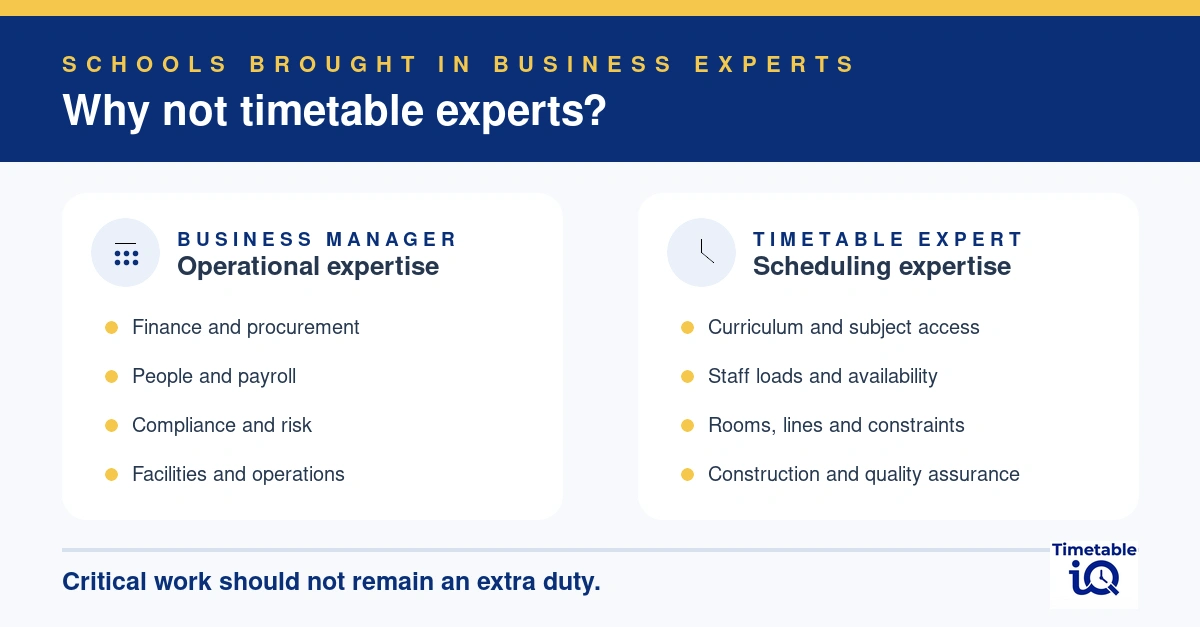
Schools brought in business managers as finance, staffing and compliance became too complex to remain an extra duty. Timetabling has reached the same point.
Sep 8, 2026
There was a time when much of a school's administration sat close to the principal's desk.
Budgets were smaller, staffing arrangements were simpler and many decisions were made centrally. As schools became more complex organisations, that model stopped working.
Schools did not respond by asking principals to become part-time accountants, procurement specialists, HR advisers and facilities managers. They increasingly brought business expertise into the school.
The same logic should now be applied to timetabling.
The rise of the school business manager
There is no single Australian date when schools "started getting business managers". Government, Catholic and independent schools developed differently, and the role appeared under names including bursar, registrar, administration officer and business manager.
The history still shows a clear progression.
Independent schools had bursars managing business operations by at least the 1960s. In Western Australia, seven school bursars formed a professional association in 1968 (Association of School Business Administrators WA history).
Victoria's registrars were meeting in regional groups in the 1960s and formed a statewide association in 1975. Primary-school business managers joined that professional community in the mid-1990s as Schools of the Future reforms shifted more responsibility to individual schools (Business Managers Victoria history).
Queensland provides a clear milestone. On 8 April 1990, Education Queensland established a Registrar position in every state school with more than 600 students. The broader role covered finance, human resources, facilities and technology. It was ultimately renamed Business Manager in 2017 (School Business Managers' Association Queensland history).
The title changed because the job changed.
Greater autonomy brought greater responsibility
The expansion of school business roles followed a major change in how Australian systems operated. Governments progressively moved budgets, decisions and accountability closer to schools.
Victoria's Schools of the Future program transferred substantial management responsibility to local school communities (Victorian Auditor-General). The ACT introduced global budgets and devolved operational responsibilities in 1997 (ACT Government). NSW's Local Schools, Local Decisions reforms began in 2012. Their evaluation found more local decision-making power but also greater administrative burden (NSW Department of Education).
Greater autonomy did not remove work. It relocated work.
When finance, staffing, procurement, assets, risk and compliance moved closer to the school, someone needed the expertise and capacity to manage them. Critical operational work could no longer remain a collection of extra tasks absorbed between educational responsibilities.
Protecting time for educational leadership
Business management was not only about better accounts. It was also about what principals should spend their time doing.
A 2017 NSW study observed principals across 119 government schools. Principals spent 40% of their time leading school management, compared with 30% leading teaching and learning. They spent 43% on administrative tasks. Three-quarters said their workload was difficult or impossible to achieve, and 77% said it was difficult or impossible to sustain (NSW Principal Workload and Time Use Study).
Victoria's 2025 review likewise concluded that excessive administration was pulling principals away from teaching, learning and educational leadership (Victorian Government review). Expertise matters, but capacity matters too.
Timetabling has reached the same point
Timetabling is often treated as an extra duty for a principal, deputy principal, head teacher or experienced classroom teacher.
That made more sense when schools offered fewer pathways, employed fewer part-time staff and had simpler curriculum structures. A contemporary timetable may need to reconcile curriculum hours, student choices, teacher qualifications and loads, non-contact entitlements, part-time availability, learning support, VET commitments, specialist rooms, class sizes, budgets and staff wellbeing.
This is not data entry. It is a high-stakes resource-allocation problem that turns a school's educational strategy into a working week.
A weak build can reduce subject access, waste rooms, fragment teacher loads, erode non-contact time and consume leadership attention through changes and complaints.
Yet schools protect finance with business expertise while leaving the timetable with a leader expected to solve a complex optimisation problem on top of their substantive role.
The best software still needs the right operator
Buying sophisticated accounting software does not remove the need for a capable business manager or accountant. The platform processes transactions and produces reports, but someone must establish the right structures, interpret the information and recognise risk.
Timetabling software works the same way.
The best platform can process thousands of constraints, detect clashes and generate schedules. It cannot decide whether the curriculum structure is sound, a restriction is necessary or a technically valid result creates an unreasonable week.
Software solves the problem it is given. Poor structures, inaccurate data and unnecessary constraints can produce the wrong answer very efficiently.
An experienced specialist knows what to ask before pressing Build:
Is the staffing model affordable?
Are unnecessary restrictions blocking a better result?
Could different lines improve student access?
Are staff availability, entitlements and resources modelled accurately?
Does the result work operationally, not just pass validation?
Software delivers its full value only when someone knows how to configure it, challenge it and interpret the result.
The hidden cost of keeping the work in-house
Assigning timetabling to an existing leader can appear cheaper because there is no consultancy invoice. That does not make the work free.
The real internal cost includes:
Salary, on-costs and release: leadership hours, relief costs and work transferred to others.
Opportunity cost: educational leadership, staff development and student support displaced.
After-hours work: evenings, weekends and holidays missing from the timetable budget.
Rework and whole-year consequences: avoidable changes, inefficient staffing and poor use of spaces.
The correct comparison is not "consultant fee versus zero".
It is the consultant fee plus a smaller amount of briefing and decision time versus the full internal cost of leadership hours, release, after-hours work, rework and displaced priorities.
A specialist can identify structural problems faster, use the software efficiently and avoid unproductive build cycles. The school buys concentrated capability when needed instead of using leadership time to recreate it once a year.
External support will not always have the lowest quoted price. The decision should be based on total cost and value, not whether the cost appears on a separate invoice.
Outsourcing does not mean handing away the school
School leaders should retain the decisions requiring local judgement: the curriculum model, student-access priorities, staffing trade-offs, wellbeing principles and non-negotiable commitments.
The specialist brings different expertise: testing whether the structure is buildable, identifying hidden constraints, modelling alternatives, operating the software efficiently and completing detailed construction and quality assurance.
This is the same distinction schools make elsewhere. The principal remains accountable for the budget but does not personally process every transaction. The leadership team owns the educational model, but that does not mean a deputy principal must personally construct every line, lesson and room allocation.
A school can commission a structure review, subject-line analysis, difficult rebuild or complete timetable. A scoped engagement lets it buy only the expertise it needs while retaining internal knowledge and control.
Schools brought in business expertise because the work became too important to remain an extra. Timetabling now deserves the same maturity.
Timetable IQ can solve one difficult problem, review a proposed structure or manage the complete timetable build. Book a conversation about where specialist support could deliver the greatest return.