Fragmented split classes may create timetable challenges, as much as they solve staffing issues.
Split classes rarely start as a problem. They start as a solution. Here's how to tell them apart, and how to timetable so the compromise version stops appearing in the first place.
Aug 13, 2026
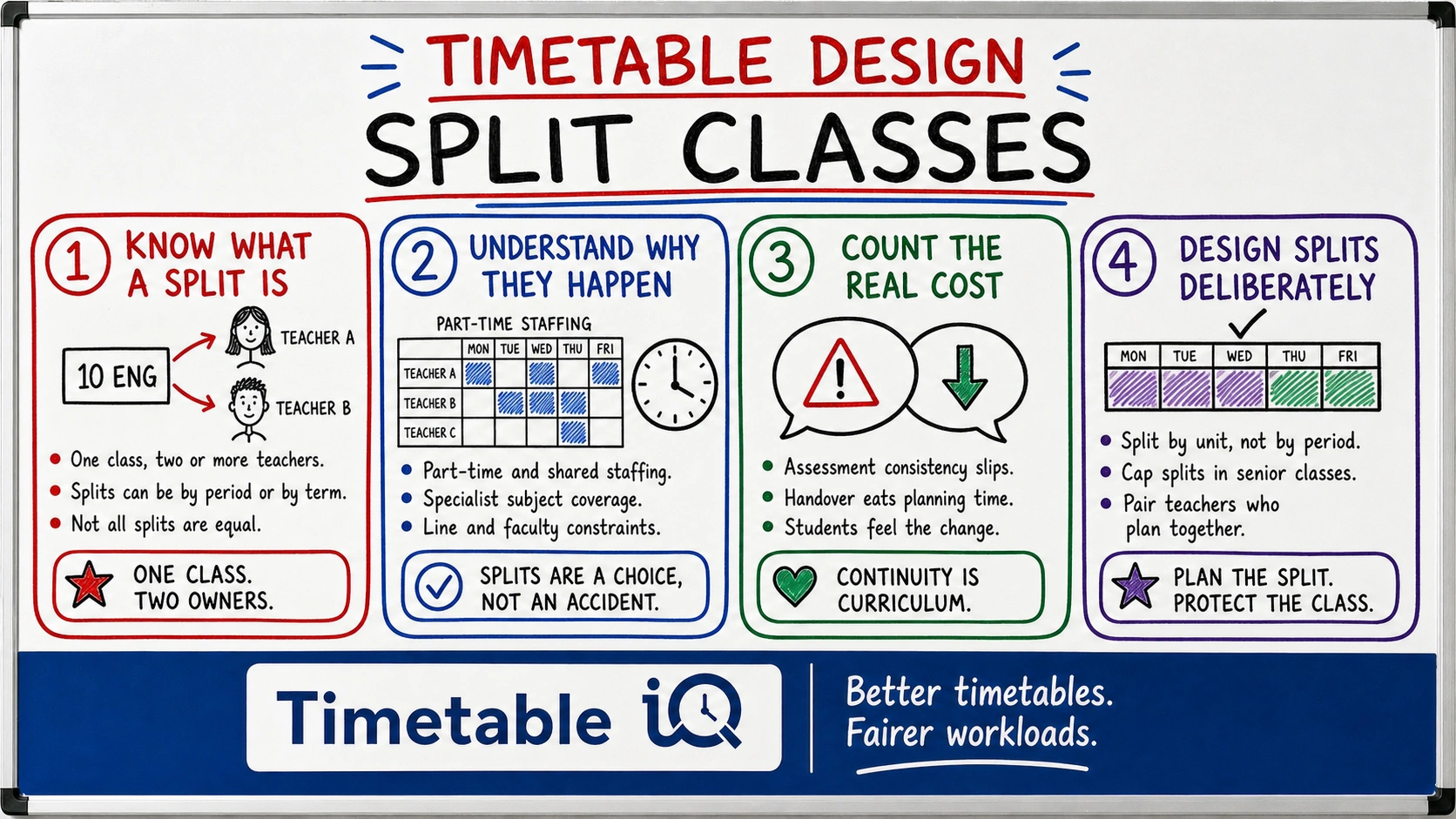
Split classes rarely start as a problem. They start as a solution. Here's how to tell them apart, and how to timetable so the compromise version stops appearing in the first place.
Split classes often get treated as a practical fix.
A teacher is part-time. A room is tight. A line will not fit cleanly. So one class gets divided across teachers or spread awkwardly across the week.
On the timetable, that can look manageable. In the classroom, it often feels anything but.
For Timetable iQ, this is one of the most important distinctions in school scheduling: a timetable can be technically complete and still educationally weak. When a class is fragmented across multiple teachers or disconnected lesson patterns, the issue is not just logistics. It is continuity.
Why continuity matters
Students learn best when teaching feels connected. Each lesson should build naturally from the last, with clear expectations, familiar routines, and a sequence that makes sense to the class.
When one class is split across teachers or days without a clear instructional structure, students can end up navigating different explanations, different pacing, different behaviour expectations, and different assumptions about what has already been taught.
That might seem minor in a single lesson. Over a term, it becomes cumulative. Momentum slows, transitions take longer, and teachers spend more time restoring clarity that should already be there.
This is especially true in subjects where learning is sequential, such as maths, science, and literacy. If the teaching rhythm is interrupted, students lose the flow that helps them move from instruction to practice to consolidation.
What fragmented split classes look like
Not all shared teaching is poor design. The real problem is fragmentation without a clear logic.
A fragmented split class often includes one or more of the following:
The class is taught by two or more teachers across the week, but the handover between them is weak.
The lessons are spaced in a way that breaks the natural sequence of learning.
Students face different routines, instructions, or expectations depending on the day.
Teachers duplicate explanations or reteach content because continuity has been lost.
This is when a class stops feeling like one class and starts feeling like a series of disconnected experiences.
When a split is considered rather than fragmented
There are cases where a split can be justified.
A better split is one with a clear delineation of work. Students should be able to understand why there are two teachers involved and how their responsibilities connect.
A simple example is when one teacher takes the theory and another takes the practical component. In subjects with workshops, labs, performance elements, or applied tasks, that kind of division can make sense because the split follows the structure of the learning rather than the weakness of the timetable.
Other considered splits might include:
One teacher leading explicit instruction while another leads tutorials, workshops, or guided practice.
One teacher taking the main group while another handles intervention or extension through alternative or parallel teaching.
Content divided deliberately into stations or components, with each teacher responsible for a planned part of the lesson sequence.
Shared delivery in skills-based subjects where the split reflects the nature of the course, not just a staffing workaround.
Even then, the split only works when the sequencing is explicit. Theory and practical cannot operate as separate islands. They still need one learning arc.
What timetablers should do instead
The best way to avoid poor split classes is to timetable for continuity first.
That means treating intact teaching sequences as something to protect, not something to trade away late in the build.
In practice, that means:
Starting with the most constrained resources first, especially part-time staff, specialist rooms, and fixed lessons,
Keeping classes with the same teacher for a full learning sequence wherever possible.
Treating split classes as an exception to justify, not a default solution,
Testing multiple timetable scenarios before locking in a structure that creates continuity problems downstream.
A useful question for every proposed split is this:
Would this still feel like one coherent class to a student?
If the answer is no, it is probably not a good split. It is probably a timetable compromise that will show up later as a teaching problem.
If a split cannot be avoided
Sometimes schools do not have a perfect option.
When a split is unavoidable, the priority should shift to preserving as much continuity as possible. That requires more than goodwill. It requires structure.
The strongest safeguards are straightforward:
A shared pacing guide.
Common language for routines, instructions, and success criteria,
Short, regular planning check-ins.
Shared resources and assessment tools.
Clear handover notes after lessons.
These are not extras. They are the minimum conditions for making a split arrangement work without undermining the student experience.
The real test of a good timetable
A timetable is not successful because every box is filled.
It is successful when it creates the conditions for coherent teaching and sustained learning. Fragmented split classes might relieve construction pressure during timetable build season, but they often create avoidable friction for the rest of the year.
For school leaders and timetablers, that is the real challenge: not just making the timetable fit, but making it educationally sound.
At Timetable iQ, that is the lens worth keeping. Protect continuity first, and this occurs early in the timetable process, at line construction stage. Split only with purpose. And where a split is necessary, make the educational logic visible to students, teachers, and leaders alike.
Janice Edwards - Timetable iQ - August 2026