Every School Is Different: Why AI Still Needs a Timetable Plan - Part 1
AI can help build a school timetable, but it cannot replace planning. Every school has unique structures, constraints and priorities that must be defined first.
Aug 27, 2026
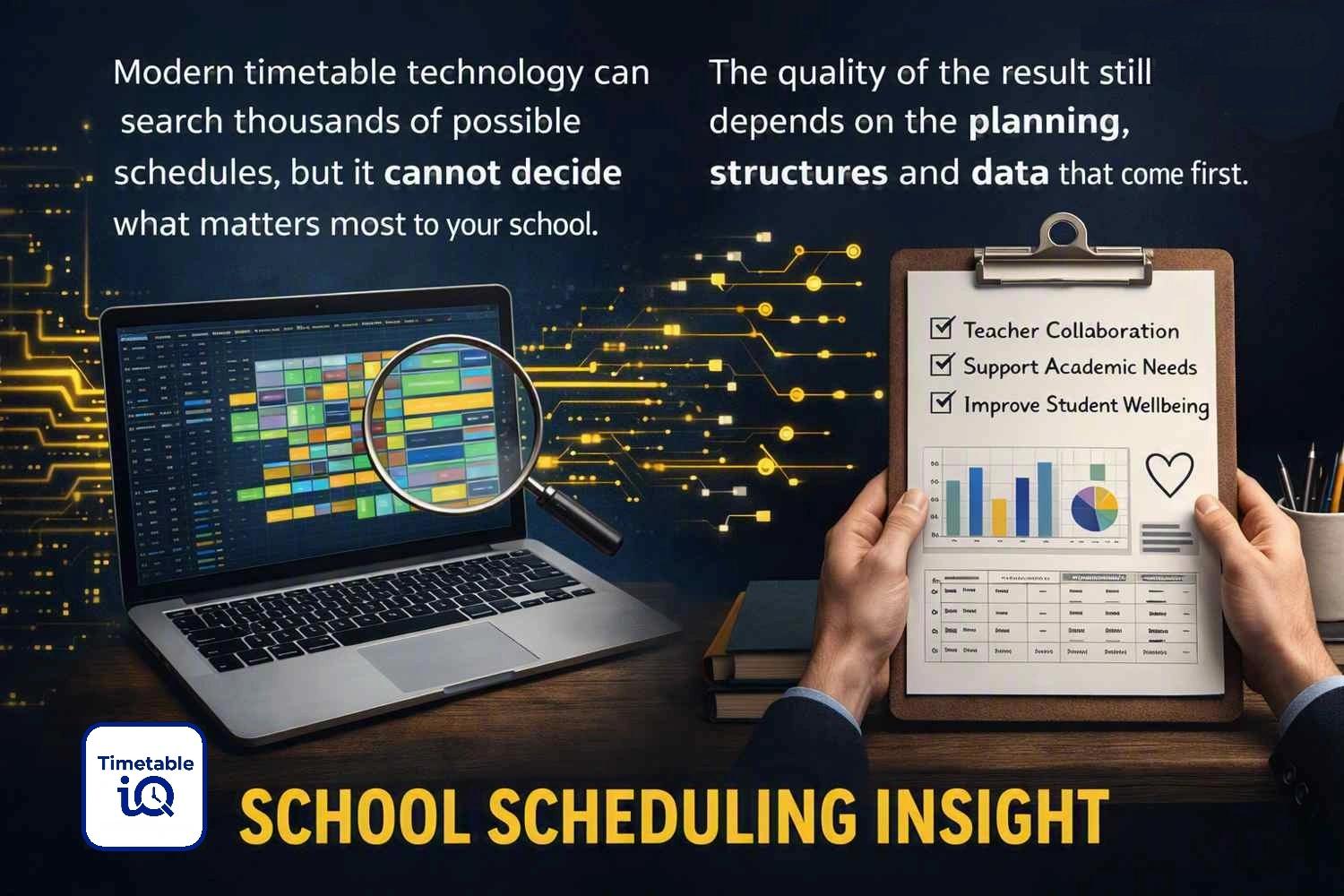
There is an appealing promise attached to AI and school timetabling.
Enter the teachers. Add the classes, rooms and subject requirements. Press a button. Let the system make everything fit.
It sounds reasonable. AI can process far more combinations than a person could ever examine manually. It can identify clashes, test alternative placements and improve a schedule against a long list of requirements.
But a school timetable is not simply a large jigsaw puzzle with one correct answer.
Every school is different. The structure that works beautifully in one school may be impossible, unaffordable or educationally unsuitable in another. AI can only work with the version of the school it has been given. If that version is incomplete, contradictory or based on last year’s assumptions, the technology may build the wrong timetable very efficiently.
AI can help construct a timetable. It cannot plan the school for you.
No two schools are solving the same problem
Two schools can teach the same curriculum, operate under the same jurisdiction and use the same number of periods each week, yet require completely different timetables.
One may have a large senior cohort with broad subject choice. Another may depend on mixed-grade electives to keep smaller subjects viable.
One may employ several part-time teachers with fixed availability. Another may have mostly full-time staff but rely heavily on specialist teachers shared across multiple year groups.
One may have several science laboratories, workshops and commercial kitchens. Another may have one specialist room that every practical subject is competing to use.
One may need to protect regular blocks for VET, TAFE or workplace learning. Another may need to coordinate learning support, EAL/D withdrawal, pastoral programs, assemblies or cross-campus travel.
These differences are not minor details added after the timetable is built. They are the timetable problem.
Research into high school scheduling increasingly reflects this reality. Work on individualised student timetables has found that schools need to balance student subject choices, class formation, class-size limits, teacher and room availability, and local scheduling conditions rather than treating every student as part of one fixed cohort (Krystallidis and Ruiz-Torrubiano, 2024).
The timetable must represent the school that actually exists, not a generic model of what a school is supposed to look like.
AI does not know what your school values
AI can be asked to optimise a timetable, but “optimise” needs a definition.
Should the timetable prioritise student subject access?
Should it reduce split classes?
Should it protect teacher non-contact time?
Should it minimise staff and student movement between rooms?
Should part-time staff receive full days away from school rather than fragmented half-days?
Should senior subjects receive particular lesson patterns? Should younger cohorts avoid certain combinations late in the day? Should pastoral care be protected even when curriculum pressure increases?
There is no universal ranking that applies to every school.
These are leadership decisions. They reflect the school’s educational model, staffing profile, physical site, community expectations and strategic priorities.
An AI system may be able to compare thousands of schedules against the priorities it has been given. It cannot decide whether those priorities are right.
If staff wellbeing is entered as a low-weight preference, the system may sacrifice it to solve room pressure. If a room requirement is marked as mandatory when it is actually flexible, the build may become unnecessarily difficult. If every request is entered as non-negotiable, there may be no feasible timetable at all.
The technology is not making a value judgement. It is following one.
Planning turns school knowledge into a timetable model
Effective school timetable planning starts before lessons are placed on a grid.
The first task is to describe the school accurately enough for any scheduling system, AI-enabled or otherwise, to work with it.
That means making deliberate decisions across five areas.
Curriculum structure
The school must determine what it intends to offer and how that offer will operate.
How many classes will run in each subject? Which subjects must run concurrently? Which year groups can share a line? Where can classes be combined or split? Which courses depend on access to a particular teacher, room or external provider?
Student subject-selection data must be tested against staffing entitlement, viable class sizes, room capacity and the combinations students are trying to access.
AI can test a proposed structure. It cannot decide whether the curriculum offer is sustainable.
Staffing
A teacher’s name and availability are not enough.
The timetable model needs accurate teaching loads, subject expertise, part-time arrangements, shared classes, team teaching, leadership release and any other commitments that affect when a teacher can be placed.
It also needs clarity about what is fixed and what can be negotiated. A contracted non-working day is different from a preferred day. A staffing allocation already promised to a department is different from one still open to review.
If those distinctions are not made before the build, the timetable may preserve an assumption that should have been challenged.
Spaces and resources
Rooms are not interchangeable boxes.
A practical class may need specialist equipment, preparation space, storage, ventilation or proximity to another facility. A larger general classroom may accommodate one group but not another. A room may be physically available while being operationally unsuitable.
The same applies to shared devices, workshops, performance spaces, laboratories and transport between sites.
Accurate room data does more than prevent double bookings. It defines which parts of the curriculum can genuinely run at the same time.
Student pathways
Students are not simply year-group totals.
Their subject combinations, support needs, extension pathways and external programs create patterns the timetable must hold. A structure that maximises the number of classes offered may still reduce the number of students who can access their preferred combination.
Research into flexible high school scheduling shows why this becomes difficult: individual choices interact with class formation, class-size balance, idle time and teacher and room constraints all at once (Krystallidis and Ruiz-Torrubiano, 2024).
The question is not only “Can these classes run?” It is “Which students can actually reach them?”