5 Questions to Ask Before You Build Next Year's Timetable
Every year, around the same time, timetablers across the country do the same thing: open last year's file, take a breath, and start building again.
Aug 13, 2026
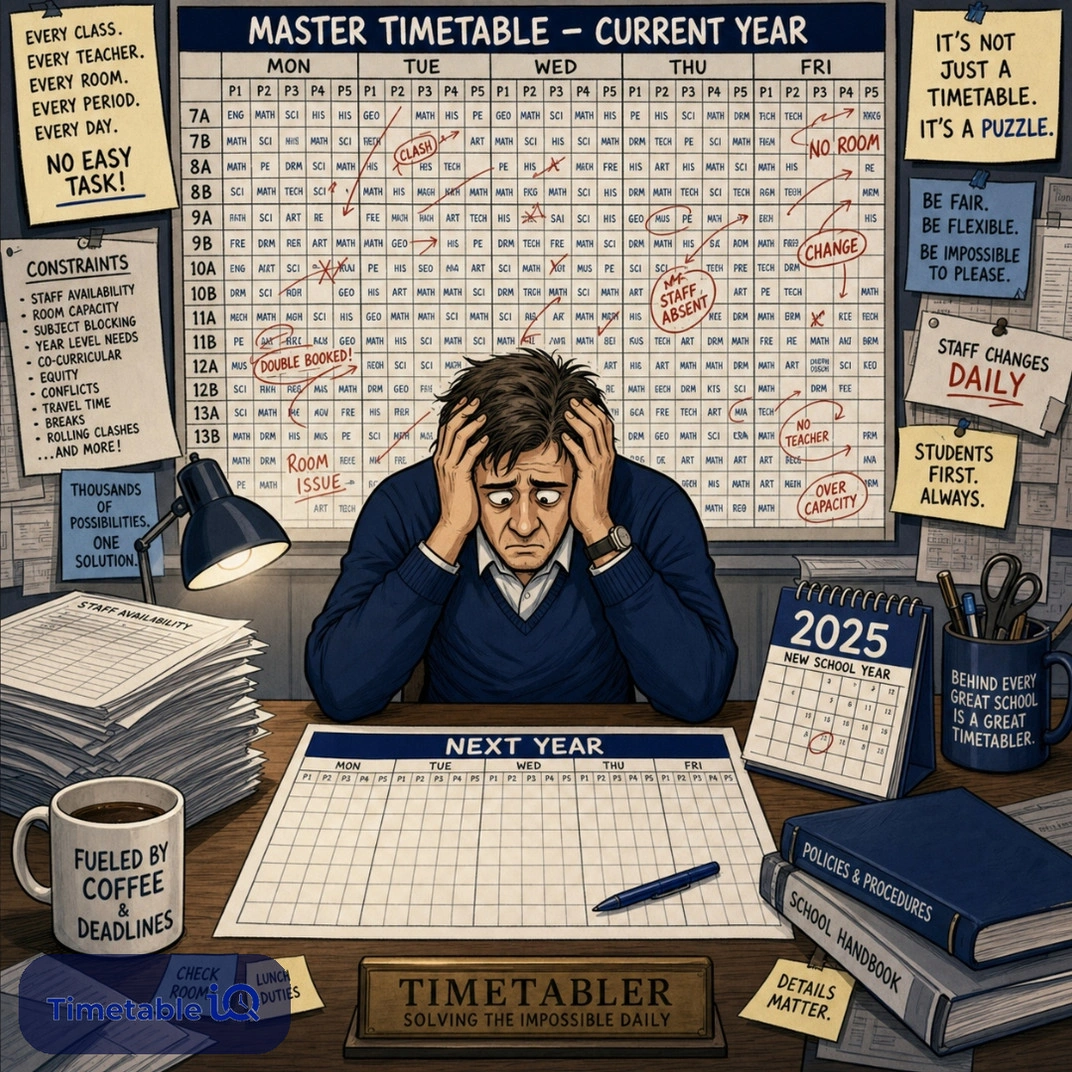
It's tempting to treat the build as the main event — the late nights untangling clashes, the back-and-forth over lines and blocks, the final version that finally holds together. But in nearly every school I've worked with, the timetable that causes the most grief in Term 1 wasn't broken by a scheduling error. It was broken by a decision — or a missed conversation — that happened weeks before anyone opened the software.
The build is where problems show up. It's rarely where they start.
So, before you open the software and start building this year's timetable, here are five questions worth sitting with first.
1. Where did last year's timetable create the most complaints — and why?
Every school has a pattern. It might be Year 11 students with fragmented lines across three periods a day. It might be the same three teachers copping back-to-back classes with no non-contact break in between. It might be a specialist subject that always ends up squeezed into whatever slot is left over once everything else is placed.
The mistake most schools make is treating last year's complaints as one-off frustrations rather than data. If the same issue surfaces two years running, it's not bad luck — it's a structural problem in how the grid, the lines, or the staffing allocation are set up. Before you build, go back through last year's feedback — from staff, from students, from parents — and separate the noise from the signal. What's an isolated gripe, and what's a symptom of something the new build needs to solve properly rather than paper over again.
2. Has anything changed in the school's staffing, curriculum, or leadership that the new timetable needs to reflect?
A timetable is a snapshot of a school's current reality — its staffing establishment, its curriculum offering, its leadership structure, its compliance obligations. When any of those shift, the timetable has to shift with them, or it will be fighting the school's own operating conditions from day one.
Ask directly: has the staffing establishment changed — new appointments, departures, part-time arrangements, maternity or long-service leave? Has the curriculum model changed — new subject offerings, a shift in elective structures, updated syllabus requirements? Has anything changed at the leadership level, including new executive teaching time obligations under policies like the NSW Executive Teaching Time Review, which now requires many Deputy Principals to carry a teaching load alongside their timetabling and leadership responsibilities? Each of these has direct, practical implications for how lines are structured and how staff are deployed. Miss one, and you're not building this year's timetable — you're rebuilding last year's with a few patches.
3. Is the subject selection data clean, complete, and realistic?
This is the one that quietly sinks more builds than any software limitation ever will. A timetable can only ever be as good as the data that feeds it, and subject selection data is almost always messier than it looks on the surface.
Look for the usual suspects: students who selected subjects that clash with prerequisites or with each other once electives are blocked, enrolment numbers that are wildly out of step with what actual class sizes will bear, "phantom" selections from students who have since left or changed pathway, and elective combinations that were technically allowed in the selection process but are practically impossible to timetable without an unreasonable number of lines. If subject selection was rushed, unclear to students and parents, or collected without checking feasibility against staffing, the data will look complete on a spreadsheet and still fall apart the moment it hits a real grid. Clean this before you build, not while you build — chasing down data errors mid-construction is one of the most common causes of blown timelines.
4. Does the current grid structure still suit the school's curriculum model?
The grid — the number of periods, the length of the day, the pattern across the week, the way lines are blocked — is usually the most inherited, least questioned part of the whole process. Many schools are still running a grid structure that was set up years ago for a curriculum model, staffing establishment, or bell-time arrangement that no longer exists.
That doesn't mean the grid needs to change every year. It means it deserves a genuine check, not an assumption. Does the current period length still suit the way subjects are being delivered, particularly practical and project-based subjects that need longer blocks? Does the current structure still support the school's approach to composite or stage-based classes? Is the grid creating unnecessary fragmentation for senior students, or unfair non-contact distribution for staff? If the answer to any of these is "we've just always done it this way," that's worth treating as a flag, not a reassurance.
5. Who needs to be consulted — and when — before the build locks in?
Timetables affect almost everyone in the school, but very few of those people get a genuine say before decisions are locked in. That gap is where a lot of the political friction around a new timetable comes from — not because the outcome was wrong, but because it landed on people who had no chance to flag a problem while it was still fixable.
Before the build starts, map out who actually needs to be consulted, and at what point their input still has room to matter. Head teachers and faculty leaders usually need to weigh in on staffing allocation and specialist requirements before lines are locked. Support staff and learning support teams need visibility over students with individual timetable requirements well before the final draft. Senior leadership needs to sign off on how policy obligations — teaching loads, non-contact entitlements, compliance requirements — are being met, not after the timetable is published, but while there's still time to adjust. Consultation that happens after the build is finished isn't consultation — it's damage control.
The build is the easy part to blame
The timetable is one of the most complex documents a school produces every year, and it's an easy target when something goes wrong, because it's the thing everyone can see and everyone is affected by. But the mistakes that haunt a timetable all year rarely happen during the build. They happen in the weeks before it — in the data that wasn't checked, the change that wasn't flagged, the conversation that didn't happen in time.
If you're stepping into the next build and want a second set of eyes on any of these five questions before you commit to a structure, that's exactly what we do at Timetable iQ.
Less timetabling stress, more school focus.
Janice Edwards - Timetable iQ