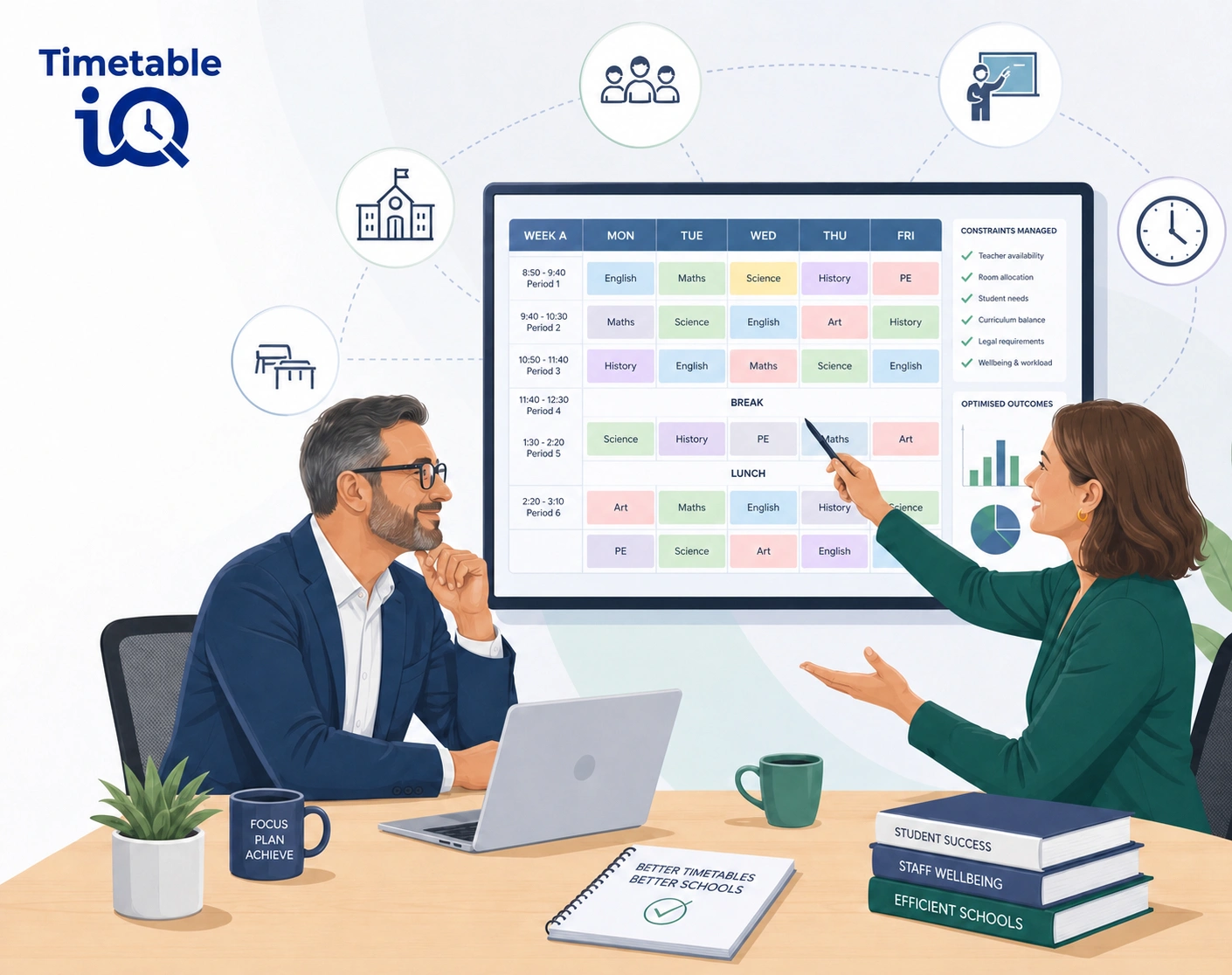
Modern school timetables have to balance far more than “teachers + classes + rooms”
Why School Timetabling Is a Strategic Function, Not an Admin Task
School timetabling has shifted from an administrative task to a strategic function. A modern secondary timetable has to balance diverse curriculum and VET pathways, part-time and job-share staffing arrangements, learning support and extension programs, and shared or split-campus facilities — and every one of those constraints interacts with the others. Treating it as scheduling rather than infrastructure risks hidden clashes, inequitable staff load, and structures that quietly undermine the school's strategic priorities.
Modern school timetables have to balance far more than “teachers + classes + rooms”.
They must account for:
Diverse curriculum offerings and VET pathways
Staff load, part‑time arrangements and industrial requirements
Learning support, extension programs and wellbeing initiatives
Shared facilities, split campuses and specialist rooms
Each constraint interacts with the others. A small change in one area can ripple across dozens of classes and staff members. Treating this as a simple admin task increases the risk of hidden clashes, inequities in load, and patterns that quietly undermine key strategic priorities (like literacy blocks or senior subject pathways).
An expert timetabling partner brings a systems mindset – seeing the timetable as an engine for school improvement, not just a grid of periods.
Better educational outcomes through intentional design
A timetable built “under pressure” often focuses on solving immediate conflicts rather than optimising for learning.
In contrast, experts can design around educational priorities such as:
Protected literacy and numeracy blocks in primary and junior secondary
Senior subject lines that maximise viable combinations for students
Minimising split classes and staff changes that disrupt continuity
Thoughtful structuring of double periods, practical lessons and project time
Because specialists have worked across many schools, they know what patterns tend to support improved attendance, engagement and results – and what structures repeatedly cause friction. They can help leaders test scenarios, quantify trade‑offs and align the timetable with the school’s teaching and learning framework.
Protecting staff wellbeing and workload equity
When timetables are built in isolation, staff workload issues often surface only after the year begins: awkward spreads of duties, uneven load distribution, or “unlucky” teachers with too many late finishes or challenging combinations of classes.
Timetabling experts can:
Analyse load equity across faculties and roles
Flag high‑risk patterns (e.g. too many yard duties clustered for certain staff)
Build in safeguards that support wellbeing and retention
This kind of intentional design builds trust. Staff see that leadership has taken their working conditions seriously and used specialist support to get it right – not simply relied on manual trial‑and‑error.
Saving time and reducing risk for school leaders
For many deputies and timetabling coordinators, the timetable is a yearly source of stress that competes with strategic leadership. Weeks can disappear into manual adjustments, re‑checking clashes and responding to late changes.
Working with an expert:
Compresses the timetable build cycle, freeing leaders to focus on pedagogy, behaviour and community engagement
Reduces the risk of critical errors that lead to timetable re‑builds mid‑year
Provides a clear audit trail of decisions and constraints, which is invaluable when explaining choices to staff and parents
Instead of one person “owning” all the complexity, schools gain an experienced partner who can share the load and introduce more robust processes.
Leveraging specialist tools and hard‑won experience
Even with good software, truly effective timetabling requires deep knowledge of how to model a school’s unique context inside those tools.
Specialists bring:
Advanced use of timetabling platforms that most schools barely tap into
Pattern libraries: tried‑and‑tested structures for different school types and sizes
Benchmarking insight from other schools facing similar challenges
This means schools benefit not just from one person’s experience, but from a wide body of practice. Mistakes that other schools have already made and learned from are less likely to be repeated.
Building internal capacity, not dependency
A common concern is that bringing in an external expert might weaken internal skills. In reality, the best partnerships do the opposite.
Expert support can be structured to:
Coach the existing timetabler and leadership team through each phase
Document processes and decision rules so future builds are smoother
Provide templates and checklists for ongoing maintenance and mid‑year changes
Over time, the school’s internal capability grows – supported by a trusted specialist who can step in for complex changes, new curriculum structures or major growth.
A practical leadership choice, not an admission of defeat
The most important message for LinkedIn readers – especially principals and business managers – is this: choosing expert timetabling support is not about “not coping”; it is about treating the timetable as mission‑critical infrastructure.
Bringing in specialised help:
Signals to staff and your community that you take learning time, equity and wellbeing seriously
Reduces the personal burden on one or two key leaders
Aligns timetabling decisions with the school’s strategic plan, rather than leaving them to chance
In a landscape where schools are expected to do more with finite resources, partnering with a timetabling expert is one of the most leveraged decisions a leadership team can make.
Thinking about your own school, where do you see the timetable causing the most hidden pain – student pathways, staff workload, or facility use – and how might expert support change that?
Janice Edwards - Timetable iQ
Did you find this article useful?
Drop me a messsage at support@timetableiq.com.au if you have a topic you would like to read about in the world of school timetabling.